What the ASD is telling Australian businesses about AI in 2026
The Australian Signals Directorate spent the first half of 2026 publishing a steady stream of AI guidance, and the message is blunt. Improve your security fundamentals now, because attackers are already using AI to move faster than you are. If you run a business and you have switched on AI faster than you have governed it, the national cyber authority has effectively written your reading list.
Every publication below is from the ASD, through its Australian Cyber Security Centre, and linked so you can read it in full. What follows is the pattern across them, and the short list of things a normal business should do about it.
What is the most recent ASD AI guidance?
As of late June 2026, the ASD’s most recent AI publication is a joint statement from the leaders of the Five Eyes cyber security agencies, released on 22 June 2026. The head of the ASD’s ACSC, Stephanie Crowe, signed it alongside her counterparts in the United States, United Kingdom, Canada and New Zealand. It is short, blunt, and aimed at boards and executives more than at IT teams.
The core message is that AI is compressing the timeline. Frontier models are expected to reshape both attack and defence, and the agencies put it plainly. The window in which your security assumptions stay valid is now measured in months. AI lowers the barrier for attackers and shrinks the gap between a vulnerability being found and exploited, so the basics you have been deferring are the ones that now matter most.
What stands out is who the statement is written for. It puts cyber resilience on the board’s desk and tells executives to make sure their controls hold up under pressure, and to give their cyber leaders the authority and resources to act on them. The practical asks are familiar and now urgent. Reduce your attack surface, patch faster, retire legacy systems that have become strategic liabilities, tighten identity and access controls, and rehearse your incident response on the assumption that a breach will happen. Secure-by-design and secure-by-default, it says, have to become standard practice.
Two weeks earlier, the same agency published “Opportunities for AI in cyber defence” (27 May 2026), an Australian-authored piece on using AI securely in your own defensive operations, structured around the six functions in the ASD’s Information Security Manual: Govern, Identify, Protect, Detect, Respond and Recover. Its framing is more even-handed than you might expect. Instead of casting AI only as a threat, it covers defenders using AI to keep pace, on the understanding that both sides are now adopting it at greater speed and scale. The caveat that runs through everything the ASD published this year holds here too. AI helps, but only on top of fundamentals that are already solid.
What has the ASD published about AI in 2026?
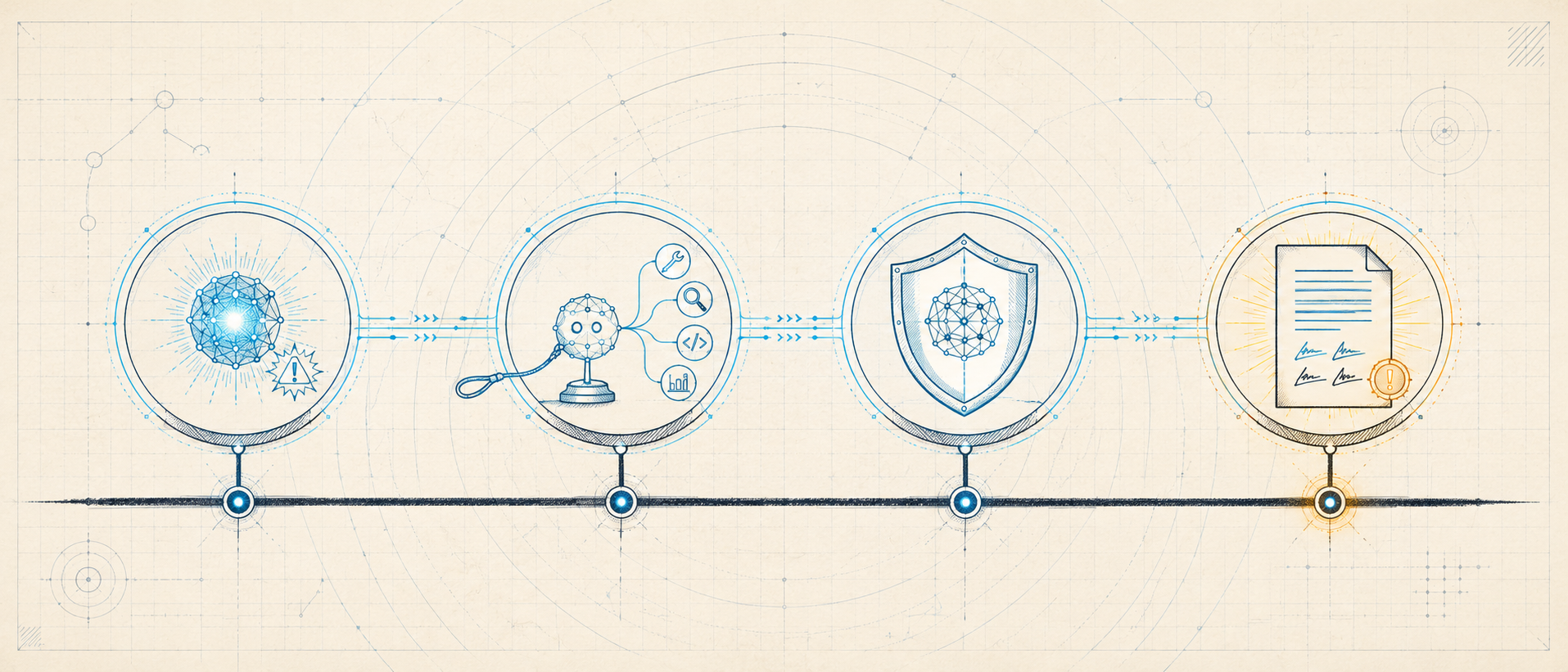
The ASD released a connected series of AI publications through 2026, each building on the same core message about fundamentals, speed, and oversight. Taken in order, they read less like isolated advisories and more like a single argument delivered in instalments.
- Late April 2026, Frontier AI models and their impact on cyber security (updated). The ASD’s assessment is that frontier models lower the cost, effort, and expertise needed to find and exploit vulnerabilities. The attack techniques have not fundamentally changed; the speed and scale have. Work that used to take months can now take hours, which is why the advice is to improve your fundamentals now rather than wait.
- 1 May 2026, Careful Adoption of Agentic AI Services. A joint Five Eyes publication with the United States, United Kingdom, Canada, and New Zealand cyber agencies, and the first coordinated multi-government guidance aimed specifically at agentic AI. More on this below, because it is the one most likely to land on a business roadmap.
- 27 May 2026, Opportunities for AI in cyber defence. Covered above.
- 22 June 2026, Five Eyes cyber security agencies statement. A leadership-level call to action signed by all five agencies, pressing boards to treat AI-driven cyber risk as a business problem and to get the basics right fast. The most recent of the set, covered above.
These sit on top of earlier anchors on the ASD’s artificial intelligence hub, including its 2025 guidance on securing the data used to train and operate AI systems, and the older “Engaging with Artificial Intelligence” and secure AI development guidance.
Keep one thing straight here. A separate June 2026 milestone, the first mandatory requirement under the Digital Transformation Agency’s policy for the responsible use of AI in government, is a DTA policy for government agencies rather than an ASD cyber-security publication. It matters if you sell to government, but do not confuse it with the ASD’s advice.
Why is the ASD so focused on agentic AI?
The ASD and its Five Eyes partners singled out agentic AI because handing an AI system the ability to act, not just answer, is where the risk multiplies. An agent that can read your email, query your systems, and trigger actions has a far larger attack surface than a chatbot, and a manipulated agent can cause serious damage before anyone notices.
The joint guidance lays out the failure modes plainly. Large language model weaknesses like prompt injection and data poisoning. An expanded attack surface from every tool and integration an agent touches. System complexity that lets failures cascade. And the identity problem of agents handed far more access than they need. The recommended posture is incremental. Start with low-risk tasks, give agents the least privilege that lets them work, manage them as the privileged identities they are, monitor continuously, and keep a human in the loop on anything high-impact.
This is not hypothetical. The same failure played out in public when Meta’s AI support bot handed over 20,000 Instagram accounts to attackers who only had to ask. The security stack saw nothing, because every action was authorised. Agentic AI breaks the old assumption that an attack looks like an attack.
Is the ASD’s guidance your problem?
The ASD’s guidance is advisory rather than mandatory for private businesses, but treating it as optional is a mistake, because it is the baseline everyone else will measure you against. There is no penalty attached to ignoring it. In practice, though, it is the national reference point. Government procurement leans on it, the Essential Eight that sits alongside it is frequently a contractual requirement, and when something goes wrong, “we followed the national cyber authority’s guidance” is a far better position than the alternative.
So it applies to you in the way a speed advisory applies on a wet road. Nobody fines you for ignoring it, right up until the moment you wish you hadn’t.
What should your business do about it?
Strip the publications down and the ASD’s 2026 message reduces to four moves a typical business can make without a research budget:
- Get the fundamentals solid first. The ASD is consistent that strong baseline cyber security, including the Essential Eight, is the foundation even against AI-enabled threats, and that improving it cannot wait.
- Know where AI sits in your business. You cannot govern what you have not inventoried. List the AI systems making or influencing decisions, what data they touch, and who owns each one.
- Treat AI agents as privileged identities. Limit what each agent can access and act on, the same way you would limit a powerful human account. Least privilege is the single highest-leverage control for agentic AI.
- Keep a person accountable for high-impact AI decisions. In this guidance, human oversight is treated as a control rather than a line in a policy. Someone has to be able to challenge an AI system and, when it matters, stop it.
None of that turns you into a cyber agency. It needs an owner and a baseline, which is well within reach of a small business.
What it adds up to
Read end to end, the 2026 guidance keeps making the same three points. AI has sped up both attack and defence. The security fundamentals you have been putting off are now urgent. And any system you let act on its own needs hard limits and a named owner. For a large enterprise that is a programme of work. For a smaller one it is a handful of decisions that have not been made yet, because no one owns them.
That ownership gap is the common thread. AI gets bought by one team, bolted on by another, and operated by a third, and responsibility for the risk falls between the chairs. A Fractional Chief AI Officer closes it with one accountable owner for AI strategy, policy, and risk on a retainer, and our pillar on when an Australian SMB needs that role walks through where the line sits. If your gap is the security baseline underneath the AI, our Fractional Leadership practice and Security Assessments start there. The regulators are moving the same way the ASD is: APRA has already told boards their AI literacy is not good enough.
The ASD has done something regulators rarely do. It has told you plainly, and for free, what is coming and what to do about it. Free advice gets ignored because it is free, and that is most of why it sits unread. Act on it now and you spend the next year in front of the problem. Leave it under “read later” and you spend that year catching up, most likely after an incident has made the reading compulsory.
Frequently asked questions
AI governance review
Want a straight read on what the ASD's advice means for you?
Book a free Discovery Call with InnovateX Solutions. We'll translate the ASD's AI guidance into the handful of things your business should do, scoped to how you use AI.
Senior-led and Australian-owned. We'll tell you whether your AI use needs a dedicated owner or your current leadership has it covered, and where the ASD's guidance changes your priorities.