Why I think business AI will go hybrid in 2027
Your data and IP are the gold of your business. The way you use AI should reflect that.

Todd Johnson
Founder, InnovateX Solutions
Published · 8 minute read
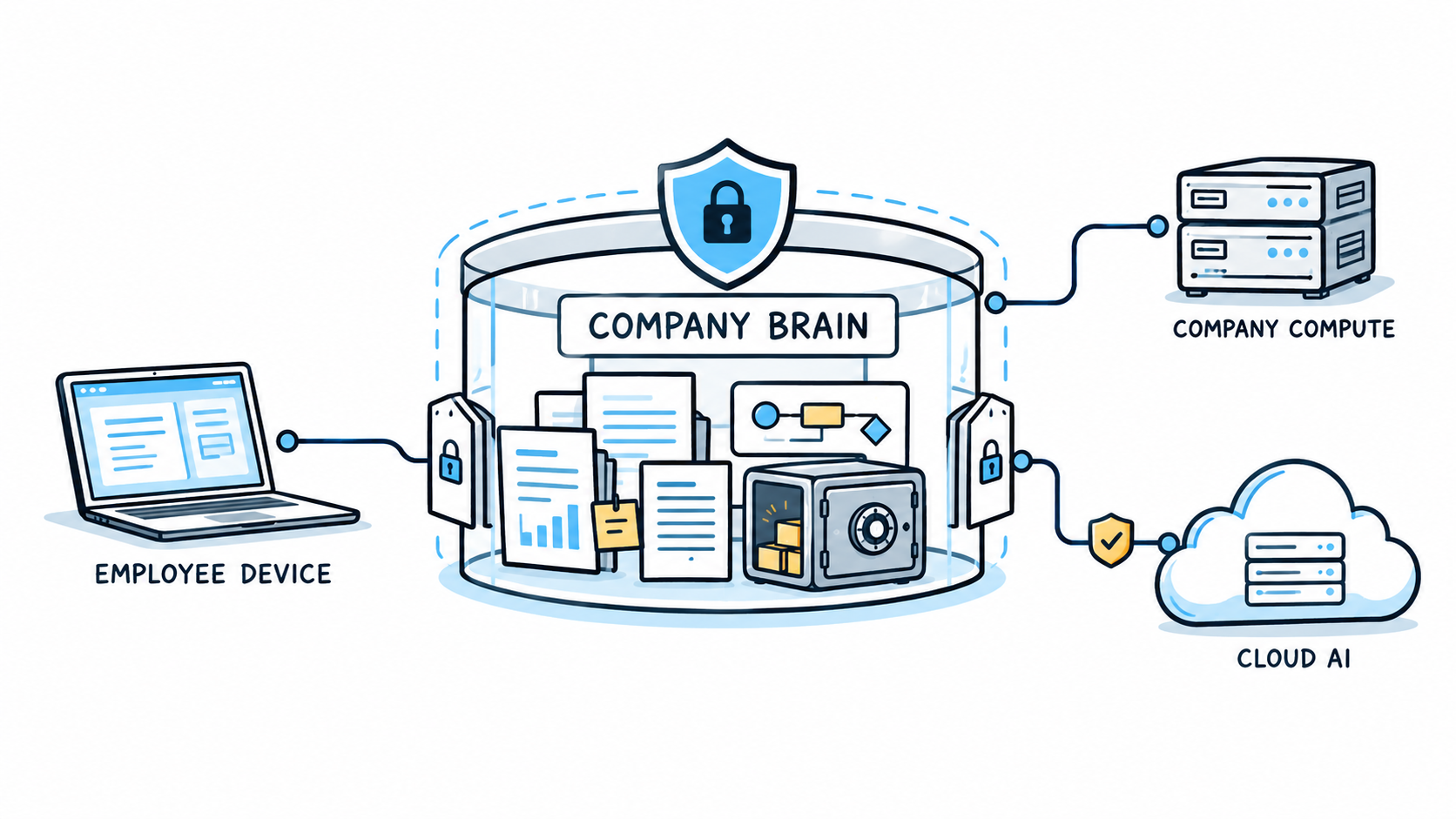
AI-created whiteboard illustration. Conceptual architecture.
Your data and IP are the gold of your business. An engineering drawing can reveal a design that took years to develop. An estimating method can explain how you price a proposal and where your margin comes from. Removing the customer’s name from either document leaves most of that value sitting on the page.
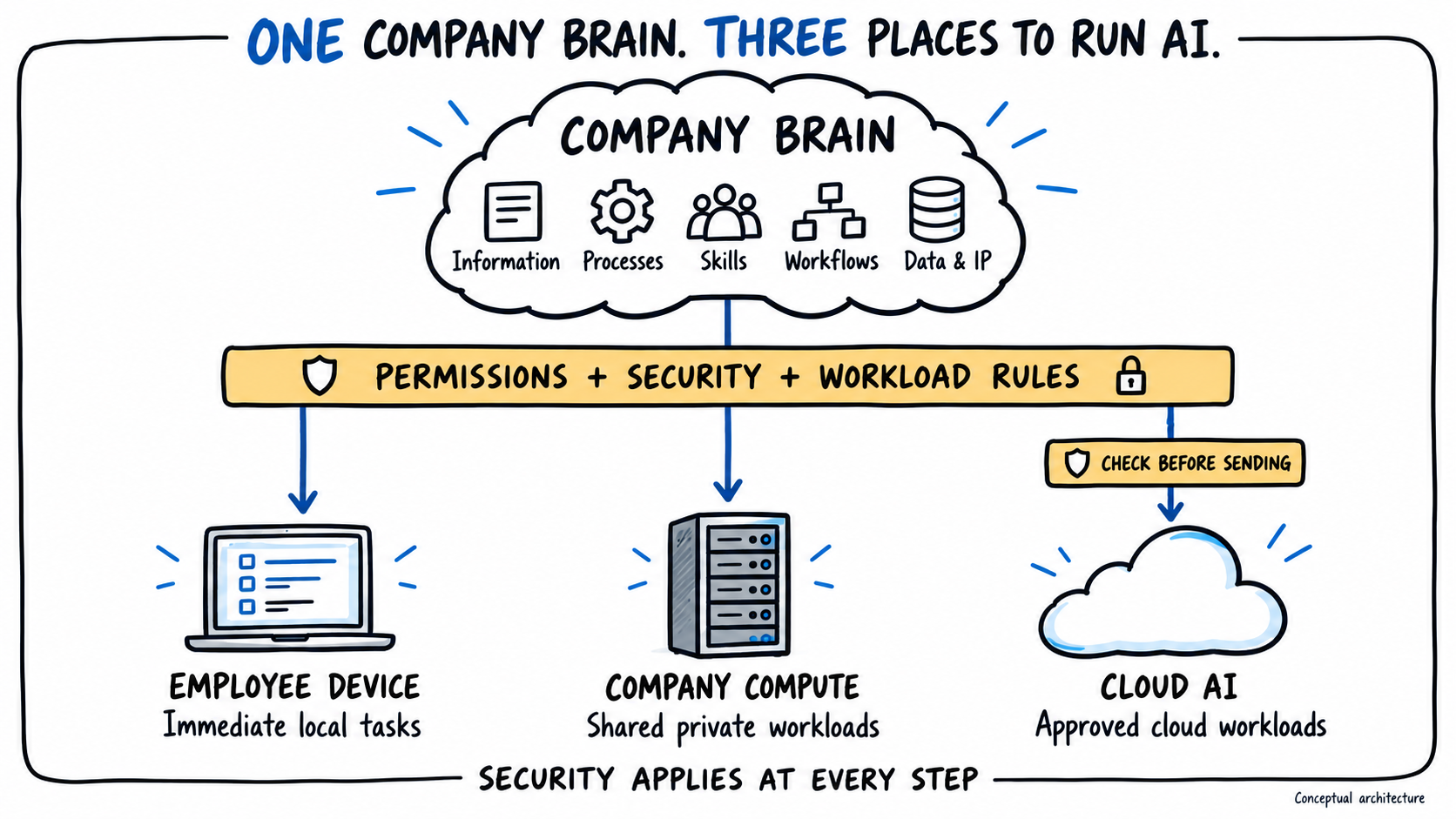
That’s why I think business AI will become much more hybrid through 2027. Businesses will want the capability of cloud AI while retaining control of information they have good reasons to keep inside the organisation. Some processing will happen on an employee’s laptop, some on computing power shared across the company, and some in the cloud. The information involved will have a considerable say in which route makes sense.
I also think we spend too much of this discussion talking about models. A model needs to know which estimating method is current, where the project records are and who can authorise a proposal. The company brain belongs at the centre of that arrangement, giving the AI access to the business’s knowledge and processes wherever the processing happens.
This is the first article in my AI in 2027 series. The next two explore personal agents and voice, followed by physical AI.
The business knowledge has to survive a change of model
Consider someone preparing an engineering proposal. They need the current estimating method, the relevant project details and a review before the proposal goes to the customer. If the business changes AI providers next month, those requirements still apply. So do the access restrictions on another client’s drawings.
That is what I mean by the company brain. It holds the processes, skills and knowledge that describe how the business operates, and directs AI through the workflows that use them. It can refer to records in the software the business already uses, without requiring every document to be copied into another database.
There is a practical difference between giving a model a folder of old proposals and giving it the current estimating method with the records a particular employee is allowed to use. The first may produce something that looks familiar. The second gives the business a basis for reviewing how the proposal was prepared and whether it followed the right process.
Gartner’s 2027 technology trends include AI context platforms, which supply agents with business knowledge. I see that as support for the importance of the company brain. As agents gain more capability, keeping their understanding of the business current becomes more consequential.
Local means more than the laptop
There are two different kinds of local computing in this discussion. A model on an employee’s laptop can read a document, extract information or assist while the device is offline. Shared company computing can take on larger internal workloads, such as comparing confidential specifications with engineering standards or processing a batch of records.
The cloud remains useful for research, demanding analysis and capacity the business doesn’t want to maintain itself. Buying a server to research public regulator publications would be difficult to justify if a suitable cloud service could do that well. Equally, sending a confidential design outside the business deserves more thought than whether a cloud model gives a better answer.
| Where processing happens | A possible use | What drives the decision |
|---|---|---|
| Employee device | Extract fields from a document or prepare a request before anything leaves the laptop. | Device security, available capacity and accuracy. |
| Shared company compute | Compare private records with internal standards or search company knowledge. | Access restrictions, processing demand and the cost of maintaining the equipment. |
| Cloud AI | Research public information or perform analysis using information the business has agreed can leave its systems. | Capability, provider terms, information exposure and cost. |
A workflow might use one of these locations throughout, or move between them. Hybrid should give a business useful choices. If every request is forced through three systems regardless of what it needs, the architecture has become an expense of its own.
What actually leaves the business?
An accounting practice offers a useful example. An accountant might want help explaining several scenarios using figures from a client’s records. A local model could extract the relevant figures, with the practice validating them against the originals before preparing a smaller request for a cloud model.
Client names and identifiers could be replaced with labels, with the mapping retained privately. The cloud model could then help draft an explanation using only the information selected for that purpose. When the response returns, the local system could restore the client references for the accountant to review alongside the source records.
That is the kind of workflow I expect to see more of: local preparation, selected cloud reasoning and a return to the private environment. It gives the business somewhere to decide what is necessary to send, rather than uploading the original document as the starting point.
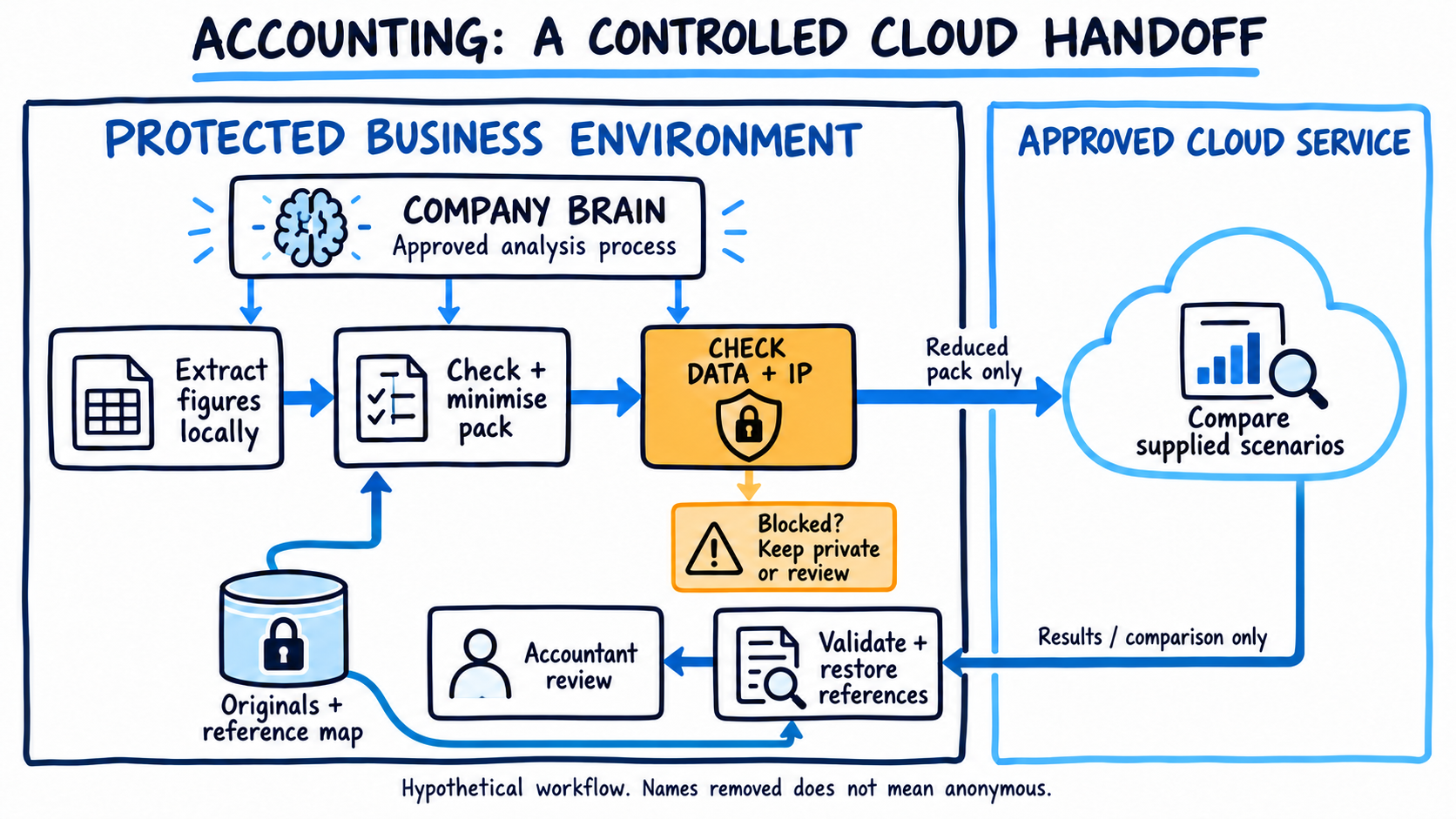
The difficult part is deciding whether the smaller request is safe to release. A label such as Client A doesn’t make the remaining information anonymous. A distinctive transaction or combination of details may still identify someone. The OAIC’s guidance on commercial AI products addresses re-identification risks and the need to minimise personal information supplied to AI services.
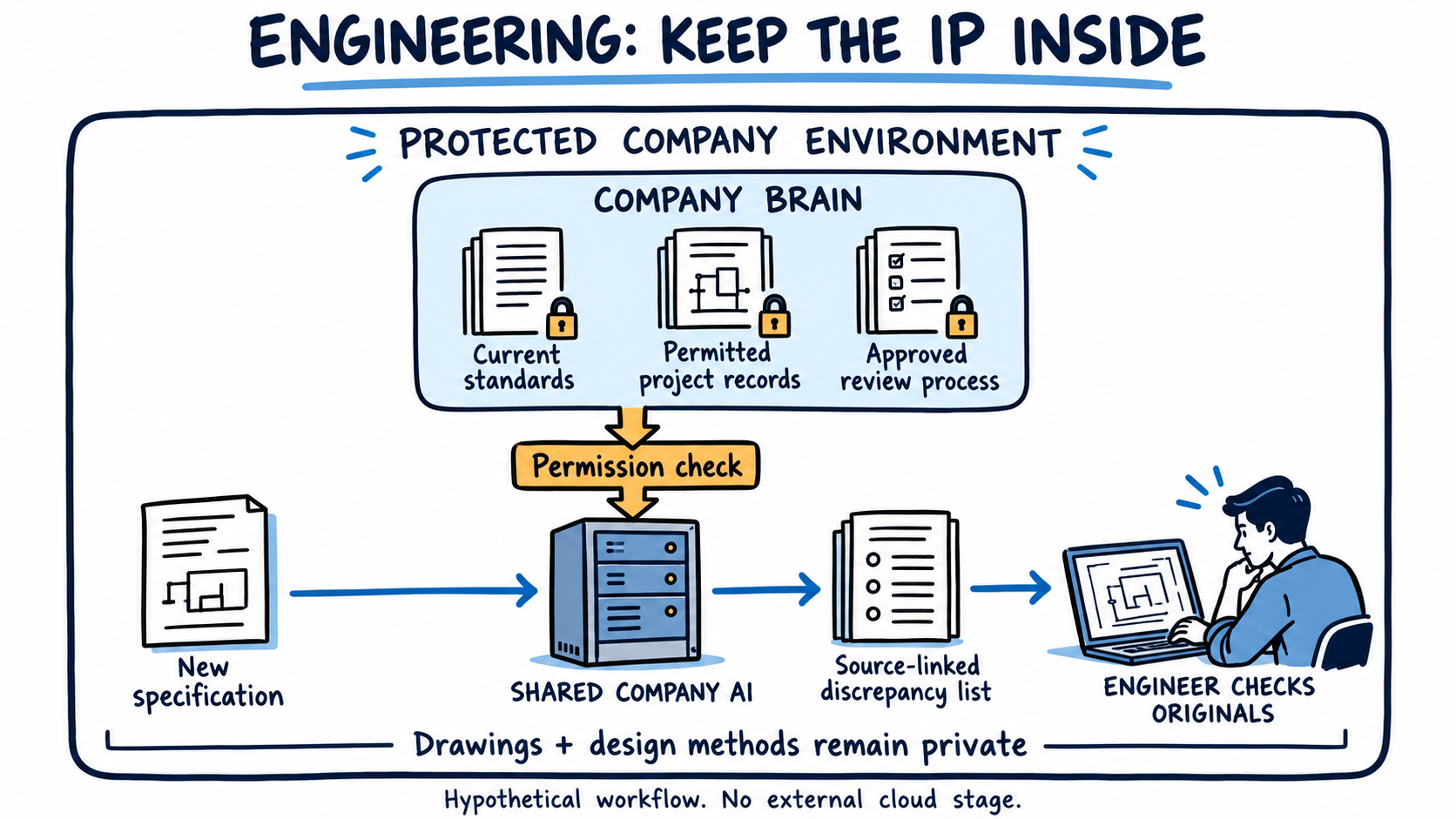
Business IP needs its own consideration. An engineer comparing a specification with internal design methods may conclude that the content itself is too valuable to send outside the organisation. In that case, shared company AI could perform the comparison privately, giving the engineer references to the original documents for review. Removing client details would achieve very little if the design method remained visible.
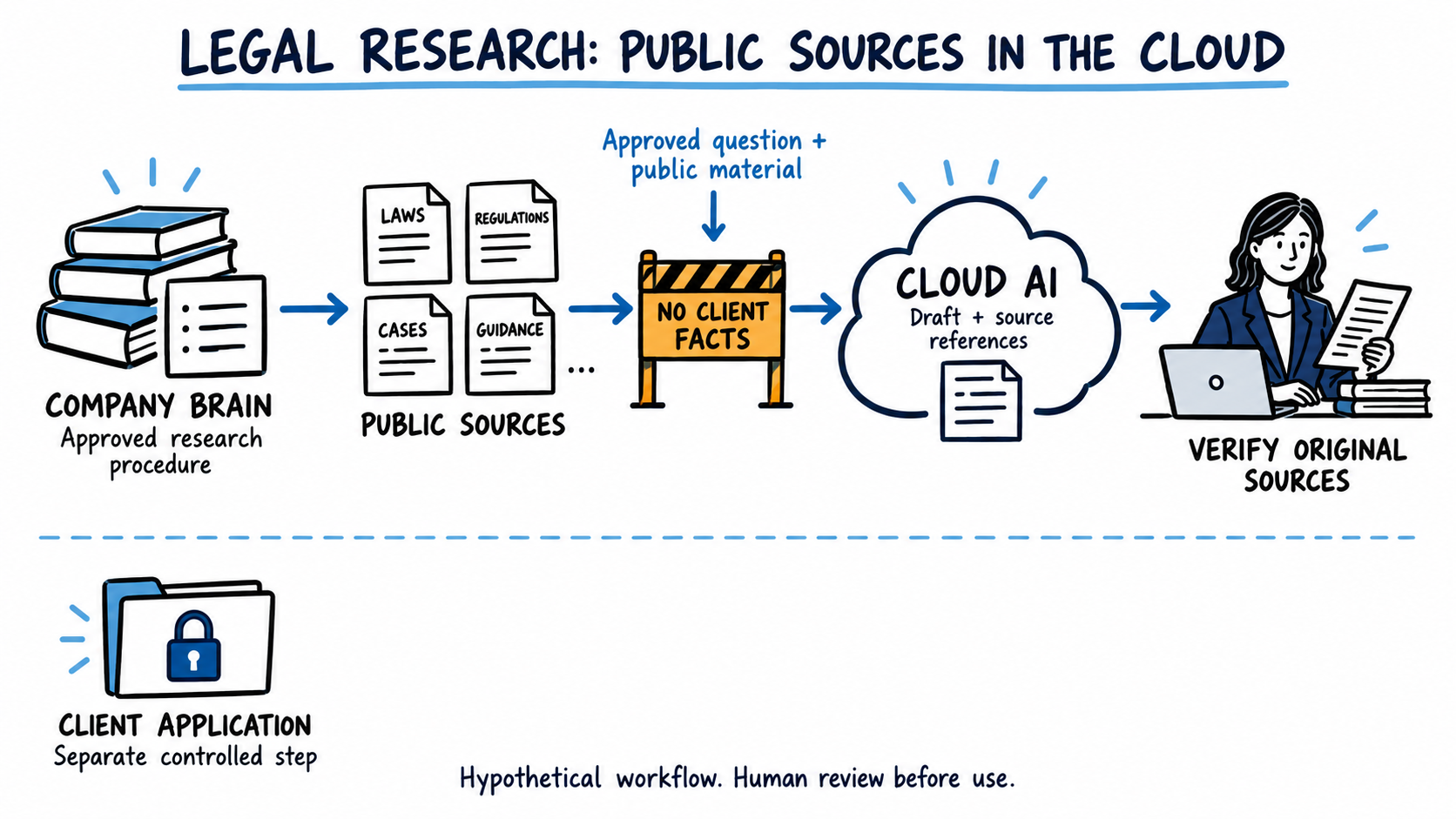
A legal practice researching public regulator publications has a different decision to make. The research request may contain no client information at all, allowing a cloud model to prepare a briefing for a lawyer to verify against the publications. Applying that research to a confidential client matter can then happen privately. These examples lead to different architectures because the information and purpose differ.
Why I expect this to become more practical in 2027
Parts of this approach are already available. Apple Intelligence processes many requests on the device and can use Private Cloud Compute for requests needing more capacity. It demonstrates a device-and-cloud arrangement within a product people already use, although a business connecting its own records faces additional integration and access decisions.
Presidio’s anonymizer provides tools for transforming detected personal information, including reversible encryption. It is one component developers can use in a privacy workflow; the business still has to establish what the detector misses and whether the remaining content is appropriate to disclose.
Smaller models also make a broader range of local processing worth considering. In April 2025, Gartner forecast that, by 2027, usage of small, task-specific models would be at least three times that of general-purpose large language models. That is a forecast rather than an adoption result, but its reasoning fits this architecture: extracting fields from a form and analysing a complicated question can have quite different computing requirements.
Together, these developments make me expect more deliberate choices about where AI runs. Regulated businesses have particularly strong reasons to investigate those choices, because they need to account for sensitive information as well as the quality of the answer. The pace will depend on whether the systems are accurate enough, affordable to operate and acceptable under the requirements of each profession.
Owning the server is only part of owning the risk
A company server can expose confidential information through poor maintenance or excessive access just as another business system can. I would be concerned by any hybrid proposal that treated moving a model into the office as the security solution.
Access has to be enforced before records are retrieved, wherever the model runs. An employee preparing an estimate doesn’t acquire a reason to read payroll because an AI can reach both systems. Similarly, instructions found inside a supplier document cannot become permission to send company files elsewhere. The software managing access and external actions has to enforce those limits.
For cloud processing, the provider’s training policy is one consideration among several. Retention, support access, processing location and onward disclosure all affect the decision. Logs and returned answers can contain sensitive material too. The route back into the business deserves the same attention as the request going out.
My expectation for 2027 is that more businesses will begin treating these as architecture decisions they can make for each process. The company brain provides continuity as models and computing locations change, while the business retains control over its knowledge. That matters because the value accumulated in your designs, records and methods lasts well beyond the AI product you happen to use this year.
If you'd like to discuss where hybrid AI could fit in your business, speak with us at InnovateX about the process you have in mind and the data and IP it depends on.
Written by Todd Johnson
Founder of InnovateX Solutions. Todd provides fractional CIO, CTO and Chief AI Officer leadership for Australian businesses and government, and wrote the XAF Connected Architecture framework.
Todd on LinkedIn