


Every organisation we work with faces the same problem: enterprise architecture that looks great on paper but doesn’t actually work in practice.
Business architects build capability models that technology teams never see. Security architects define frameworks that nobody else was consulted on. Solution architects make decisions in isolation, then everyone wonders why integration takes twice as long as planned. Each domain optimises locally while the organisation suffers globally.
Today, we’re launching XAF Connected Architecture — a modular framework designed to bridge the gap between enterprise architecture theory and delivery reality. And we’re making the framework documentation freely available at xaf.au.
Why We Built Yet Another Framework
Here’s the thing — traditional frameworks haven’t solved this problem. TOGAF, Zachman, SABSA — they’re comprehensive in theory but leave practical integration to individual interpretation. Organisations spend months building “architecture capability maturity” before delivering any value. Architecture becomes something that happens to delivery, not with it.
We’ve seen two common responses, and neither works.
The “More Governance” approach adds more gates, more reviews, more approvals. What happens? Architecture becomes resented, bypassed, and eventually irrelevant. Teams find workarounds because they’ve got deadlines to hit.
The “Trust the Teams” approach removes oversight entirely. What happens? Fragmentation, duplication, and technical debt that compounds until someone has to untangle it — usually at the worst possible time.
XAF takes a different path. We call it Connected Architecture because connection is literally the point.

What Makes XAF Different
XAF isn’t another comprehensive framework demanding wholesale adoption. It’s a modular design with a Governance Core and pluggable domain modules. Implement what you need, when you need it, at the scale that fits your organisation.
Four principles make it work:
Connect — Domains integrated by design, not through monthly status meetings where everyone presents their own work, but through systematic traceability from strategy through to solution.
Enable — Guardrails not gates. Boundaries defined upfront so teams can move without waiting for approval on every decision.
Persist — Accountability attached to systems, not buried in project archives when architects move on. Decisions and debt stay visible.
Ground — Architecture decisions are risk decisions. The framework makes this explicit rather than pretending architecture and risk are separate concerns.
The Framework Structure
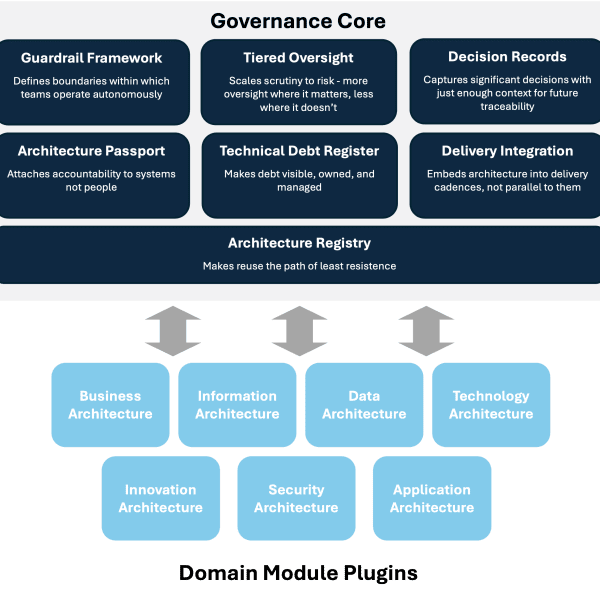
The Governance Core provides the foundation every organisation needs regardless of size or maturity. Seven components work together:
- Guardrail Framework — Defines boundaries within which teams operate autonomously. Stay inside the guardrails, no approval needed.
- Tiered Oversight — Scales scrutiny to risk. High-risk decisions get more oversight; low-risk decisions get more autonomy.
- Decision Records — Captures significant decisions with just enough context for future traceability. No heavyweight documentation theatre.
- Architecture Passport — Attaches accountability to systems, not people. When architects move on, the knowledge stays.
- Technical Debt Register — Makes debt visible, owned, and managed. Debt isn’t hidden — it’s a managed backlog item with a payback plan.
- Delivery Integration — Embeds architecture into delivery cadences, not parallel to them. Architecture activities happen at natural decision points.
- Architecture Registry — Makes reuse the path of least resistance. Patterns, building blocks, and reference architectures in one place.
These aren’t optional extras — they’re what makes architecture actually work in practice.
Domain Modules plug into the core to provide specialised guidance:
- Business Architecture — Capability models, value stream mapping, business-technology traceability
- Information Architecture — Classification, governance frameworks, business meaning
- Data Architecture — Technical implementation, storage patterns, pipelines, analytics readiness
- Security Architecture — Security reference architectures, Essential Eight alignment, control traceability
- Technology Architecture — Technology radar, platform patterns, cloud standards
- Innovation Architecture — Emerging technology assessment, AI/ML governance, experimentation patterns
Start with the Governance Core and the domain where you have the most pressing need. Add modules as your maturity grows.
Free Framework, Practical Implementation
We’re publishing the complete XAF framework documentation freely at xaf.au. Philosophy, principles, governance components, domain modules — it’s all there.
Why give it away? Because we reckon good architecture practice shouldn’t be locked behind certification fees or consulting engagements. The framework itself should be accessible to any organisation that wants to improve how they do architecture.
That said, reading documentation and implementing change are different things. For organisations wanting hands-on support, InnovateX offers Architecture-as-a-Service and dedicated implementation projects. We help you adapt XAF to your context, establish the governance mechanisms, and embed architecture into your delivery teams.
The complete license is available at https://xaf.au/license/
Get Started
Explore the framework — Head to xaf.au and start with the Philosophy and Principles sections. They’ll give you the foundation before diving into specific components.
Read the whitepaper — We’ve published a comprehensive whitepaper that covers the framework in detail, including implementation guidance and practical examples. Download it from the site.
Talk to us — If you’re facing the architecture-delivery gap and want help closing it, get in touch. We’ll have a yarn about where you’re at and whether XAF (with or without our help) makes sense for your situation.
Stay updated — XAF is evolving. We’re adding Application Architecture, Integration Architecture, and Identity Architecture modules in the coming months. Subscribe to updates so you don’t miss new releases.
Architecture frameworks shouldn’t gather dust in SharePoint. They should help you ship better solutions, faster, with fewer regrets.
That’s what XAF Connected Architecture is built to do.
XAF Connected Architecture is developed by InnovateX Solutions, a Brisbane-based IT consulting firm specialising in architecture, security, and managed services for Queensland government and enterprise organisations.
Full rights belong to InnovateX Tech Solutions Pty Ltd as trustee for the Johnson Family Trust